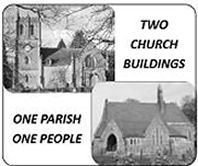
About Our Churches


Jesus says: "I am the vine; you are the branches. If a man remains in me and I in him, he will bear much fruit; apart from me you can do nothing.
John 15.5
St Paul's - 'The Church in the Woods'
A BRIEF HISTORY OF SAINT PAUL'S, PARKEND
Henry Poole was a curate at Newland and he issued an appeal for public aid towards the erection of a church and school-house in Parkend. The appeal was successful and from these voluntary funds St. Paul’s was built.
It was built on a piece of ground called Mason’s Tump by Richard James in 1820-22 under the supervision of Henry Poole who, before his ordination, had experience in architecture in Bristol. The consecration of the church took place on May 2nd, 1822.
Its moment in history came in 1831 when our churchwarden of the time Edward Machin (who was also the landowner of Whitemead Park and Deputy Surveyor of Forest of Dean) was confronted here by Warren James (who also worshipped here), leader of the local miners who had lost their ancient forest rights because of the Enclosure Acts. Asked to produce proof of their rights James returned with a pickaxe handle! This began the 1831 Forest riots which tore down all the enclosures. It all ended badly for the miners and James was sentenced to death, but Machin pleaded for him and the sentence was reduced to penal servitude in Australia, where he died.
All the old churchyard memorial inscriptions may be founds here.

Jesus says: "You are the light of the world. A city on a hill cannot be hidden. Neither do people light a lamp and put it under a bowl. Instead they put it on its stand, and it gives light to everyone in the house. In the same way, let your light shine before men, that they may see your good deeds and praise your Father in heaven.
Matthew 5.14-16
A BRIEF HISTORY OF ALL SAINTS' VINEY HILL - 'The Lantern'
Both church and vicarage were built in 1866/67 by Ewan Christian,
as a gift of Mary Bathurst, who was Lord Bledisloe's great aunt. The setting is on a highpoint above the Severn Valley, on the edge of the Forest of Dean, with beautiful views over much of the county of Gloucestershire.
The apse shape inspired W F Harvey's poem The Lantern.